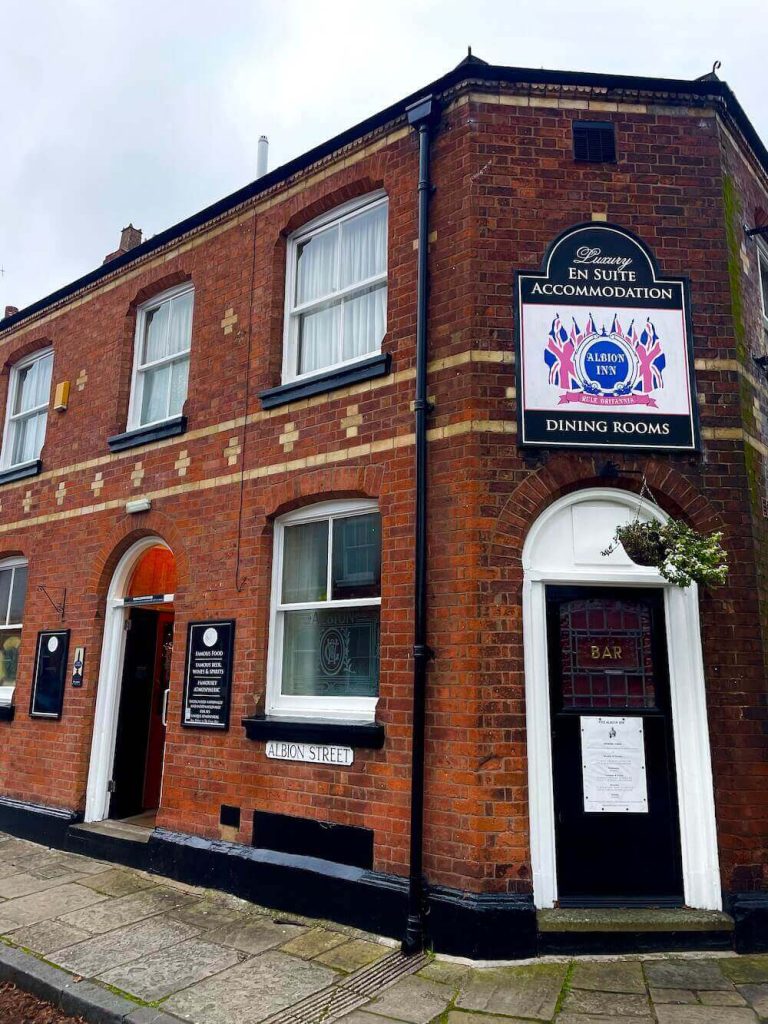
"The Albion Inn, below the City Wall on the corner of Albion and Park Street, looks like a typical back street boozer albeit festooned with flags and blackboards.
Get down to street level, though, and you become aware of the pub's unique character. The blackboard reads 'The English Pub At its Unspoilt Best' ".
So writes Stuart Maconie in his lyrical, passionate, humorous and argumentative tour de force: "Pies and Prejudice... In search of the North". He describes it as a travel
book of sorts but points out it is more of a love letter - one that makes you laugh, the best sort. Maconie loves the North of England dearly while recognizing its many
faults: "It can be grim up north, and heart stoppingly beautiful".
The Albion Inn is a true slice of Chester's history. It offers a unique experience for those looking for a traditional pub with a difference. Stepping inside feels like
travelling back in time, with its décor reflecting its rich historical roots. The pub prides itself on its heritage, maintaining a wartime atmosphere with memorabilia and
period music playing in the background.
This is a great place for anyone looking to enjoy a drink or meal in a truly one-of-a-kind setting, full of character and charm. The selection of local ales in this lovely
traditional oasis is impressive. They also serve a first class pint of Timothy Taylor Boltmaker, kept and poured to perfection. The food menu is packed with hearty British
classics.
Stuart Maconie is an English radio DJ and television presenter, writer, journalist, and critic working in the field of pop music and popular culture. He has been rightly
described as being as funny as Bryson and as wise as Orwell.
Location : Grid Ref : SJ407660 - What3Words : beard.snack.sweep - Post Code : CH1 1RN
George Henry Borrow was an idiosyncratic English author who wrote novels and travelogues based on his own experiences around Europe. Over the course of his
wanderings, he developed a close affinity with the Romani people and they figure prominently in his work. In 1854, he stayed here in the Pied Bull prior to embarking on his famous walking tour of
Wales. He recorded his experiences in his book Wild Wales (1862) in which he describes the commencement of
his journey:
"On arriving at Chester at which place we intended to spend two or three days, we put up at an old-fashioned inn in Northgate Street, to which we had been recommended". Borrow was a man who liked his
beer and in his best known book, the autobiographical Lavengro, he declares: "Oh, genial and gladdening is the
power of good ale, the true and proper drink of Englishmen! He is not deserving of the name of Englishman who speaketh against ale, that is good ale..." Unfortunately in Chester he was disappointed with
both the ale and the Cheshire cheese which: "had the appearance of soap of the commonest kind" His recourse was to open the inn window and eject "the half masticated morsel into the street". The ale
was instantly spirited out in the same fashion.
But it wasn't all bad: "Upon the whole we found ourselves very comfortable in the old-fashioned inn, which was kept by a nice old-fashioned gentlewoman, with the assistance of three servants". He was
particularly taken with one of the chamber maids who had pretty eyes and who spoke lilting Welsh which he was charmed by but: "was quite unable to understand..."
The Pied Bull is a traditional coaching Inn located near the centre of Chester on the west side of Northgate Street. Dating from 1155, this lovely old timber frame pub is the oldest licensed house in
the city still serving beer. In 1533 it was known as the 'Bull Maison' because of its proximity to the Old Beast Market. In 1784 it is recorded that one John Paul was running a regular four horse
coach service from here to Birkenhead. Today there is a cosy snug off the pillared entrance and a roomy open-plan bar beyond with an attractive mix of individual furnishings. There is a selection of
real ales and wide choice of reasonably priced food served all day.
Location : Grid Ref : SJ404665 - What3Words : shall.blame.castle - Post Code : CH1 2HQ

Victorian novelist and short story writer Elizabeth Gaskell spent much of her childhood in Knutsford. She was bought up by an aunt after her mother died when she was only a year old. Elizabeth went on to
immortalise the town as 'Cranford' in her novel of the same name. In 1960, for the centenary of her birth, a costume ball was
held in the principal inn.
The site of Royal George has been completely redeveloped for retail and leisure use. The facade has been retained and incorporates a sea food bar and grill but the
old coaching arch now gives access to a modern shopping arcade. This is a boon to Knutsford town folk but and undoubted loss to
the literary pilgrim. Mrs. Gaskell featured The Royal George Inn in several of her works. The Cranford ladies met "at the door under the carriage way" to see the magician, Signor Brunoni
perform. They went to the "cloakroom where Miss Matty gave a sigh or two to her departed youth as she adjusted her pretty new lace cap before the strange, quaint old mirror". In 'Wives and Daughters',
Roger Hamley came and went on his travels by the 'Umpire' and 'Bang up', names of actual stage coaches which called at the George.
Further along the High Street the elegant Georgian red-brick 'Angel' is still open for business. This is where Lord Maulever stayed while visiting Captain Brown, whose humble household could not entertain
such an august personage. The Cranford ladies were disappointed not to meet him socially; the only person he spoke to was "a little lad he had sworn at for driving a dirty hoop against the aristocratic
legs".
American antiques and travel writer Robert Shackleton, undertook a motoring tour of Britain in the year just prior to
the Great War. Shackleton and his three companions were Gaskell fans and delighted to start and finish their adventure in Knutsford, at The Angel which he described as an old-fashioned inn: "the very one
at which Lord Maulever aristocratically stayed, and it stands right upon the street, with the cobble- stones coming to its very door; an inn where there are excellent service and immaculate cleanliness, an
inn with beamed ceilings, an inn where there is still a 'boots' in his green apron and where they will serve you chops an inch thick, with green peas".
A booklet of Mrs Gaskell's Cranford - with a map showing the links and an introduction to her life and works is available from the Heritage Centre. The Angel, which dates from around 1710, has a spacious
interior but almost all evidence of the original fabric is now hidden under a facade of 'Olde English Tudor'.
Location : Grid Ref : SJ751788 - What3Words : scatter.decompose.verge - Post Code : WA16 6HQ

Copyright T.W. Townsend - the opinions expressed herein are those of the author and any observations were correct at the time of the review.