If the criteria for establishing England's most Literary Inn were the number of eminent writers who had visited and stayed there, then Burford Bridge Hotel, nestling at the foot of beautiful
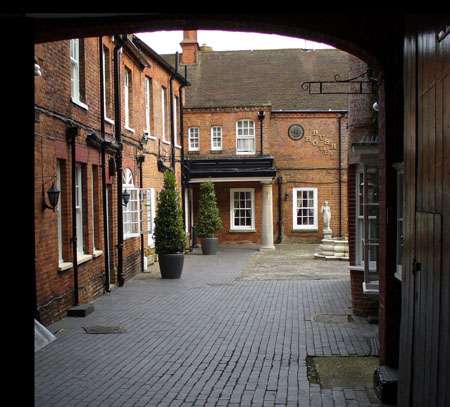
Box Hill would surely be pre-eminent. While parts of the structure date back to the 1500's, the first recorded hostelry was founded in the mid-thirteenth century. The present prestigious 57
bedroom hotel was once an old coaching inn known as The Fox and Hounds. Many of the original beams can still be seen, providing an historic ambience and unique character.
John Keats epic poem Endymion is widely regarded as one of English literature's finest. However, about a year after beginning it, progress on
the projected four books went slowly. On November 21st, 1817 the twenty-two-year-old Londoner sat writing to his friend Benjamin Bailey: "At present I am just arrived at Dorking to change
the Scene - change the Air and give me a spur to wind up my Poem, of which there are wanting 500 lines". Keats needed to get away to complete the poem which he had begun with the immortal
lines: "A thing of beauty is a joy forever". Luckily for us he found the perfect quiet retreat, a mere twenty miles from London. Keats stayed in a small back room overlooking the
stable yard. The bedroom window gives a view of lawn with fine old trees, a beech and a cedar. He must have been excited by the fact that his room was next to the one that had been occupied a
decade earlier by his boyhood hero, Admiral Lord Nelson, who stayed here when he took his last farewell of Lady Hamilton before the Battle of Trafalgar.
George Meredith is a writer little known or read these days but that was far from the case in the late 1800s. In 1867 Meredith came to live in Flint Cottage, a stones-throw from Burford Bridge.
Here, with painful slowness he wrote and rewrote the novels that finally won him recognition. A succession of distinguished writers came to visit him, many staying at the hotel. Meredith's guests,
too many to list in full, included R. L. Stevenson, Thomas Hardy, Henry James, J. M. Barrie, Robert Bridges, G. K. Chesterton, H. G. Wells, Arthur Conan Doyle and Edith Wharton.
The zigzag road up from the inn passes Flint Cottage on its way to the summit of Box Hill which is still a popular place for walks and picnics - as it was for Jane Austen, who selected it as the
setting for an excursion in Emma, which ended so disastrously when the heroine was so unkind to Miss Bates.

William Cobbett was born on March 9th 1763 in Farnham, Surrey at his father's small farm near the River Wey, in what is now Bridge Square - not far from the Farnham Maltings.
The 17th century farmhouse later became a pub called The Jolly Farmer which was renamed the Willam Cobbett in the 1970s in honour of this greatest of Englishmen.
Cobbett was born into a comparatively humble family, and as a small boy began his working life scaring the birds in the fields. He had little formal education but eventually became Member of
Parliament. Between these two occupations he was at various times, a professional soldier, farmer, publisher, author, journalist, pamphleteer, business man and one of the greatest of all political
agitators.
Generally remembered for his Rural Rides and as the founder of Hansard, Cobbett, as a political journalist,
was a thorn in the flesh of successive governments and for nearly forty years occupied a unique position of power using his brilliant pen to support the labouring poor by exposing corruption and dishonesty,
earning himself the name 'The Poor Man's Friend'. No ordinary individual before or since has had such a dominating influence in public affairs on both sides of the Atlantic. He lies buried in the
churchyard of St Andrew's in Farnham. His funeral was attended by an estimated 8,000 people.
One of the great assets of this real ale pub is the rich cross section of people it attracts. There are a lot of students at times, so it can get rather packed, but there is always somewhere to sit
(or at least to stand). There is a bust of William Cobbett in the saloon bar and in the public there is a jukebox, fruit machines, pinball, plus a pool room upstairs with 3 tables and table
football.
The small sloping beer garden behind the inn (where the tables tend to fall over) is described by Cobbett: "From my very infancy from the age of six years, when I climbed up the side of a steep sand
rock, and there scooped me out a plot of four feet square to make me a garden and the soil for which I carried up in the bosom of my little blue smock frock, I have never lost one particle of my
passion for these healthy and rational, and heart-warming pursuits".

On journeys from her Hampshire home to visit her brother Henry in London, Jane Austen�s route took her through the town of Guildford in Surrey; 20 miles from Chawton. On the left, in the lower part
of the High Street, stands the Angel Inn, the only remaining coaching inn, with records dating back to the 16th century.
The Angel was the premier inn during Jane's lifetime and today they claim she stayed there. This is unlikely as the total 48 mile journey to the capital could have been covered in around six and a
half hours. However, whether travelling in her brother's curricle, or by stagecoach, it is safe to say Jane would have used the facilities at the inn and the horses would have needed their livery services.
In a letter written at Henry's house in Sloane Street on the 18th April 1811 to her sister Cassandra, Jane says: "I have proposed to the latter (her companion Mary Cooke) that she should go to
Chawton with me, on the supposition of me travelling the Guildford Road".
The Angel was originally a monastic foundation and it still has a vaulted crypt. In the nineteenth century wall frescoes could be seen in the crypt, one showing the flight into Egypt and the other the
Crucifixion. From about 1345 the 'Fyshe Crosse' stood in the High Street near the front of the building. The cross was surmounted by a flying angel carved in stone, from which it may be assumed the inn
derived its name. The cross had been erected by the White Friars but by 1595 it had been removed to ease the movement of traffic.
Jane Austen would have known The Angel as an old timber-framed building. The stucco facade you see in the photograph was applied around 1819 and the signs added: POSTING HOUSE to indicate that fresh horses
could be hired here, and LIVERY STABLES to show that customer's horses could be cared for in their absence. Another reminder of this period is the hoist from the hayloft at the right of the inn yard.
By the eighteenth century The Angel had become a noted coaching house on the Portsmouth Road and coaches left here for London as late as 1840. In 1989 the inn was sold to property developers, who wished to
convert it into shops, but after a great public outcry planning permission was refused and the hotel was saved. In 1990 it was sold again, but this time to professional hoteliers who took great care in
refurbishing the building, retaining much of the original structure and atmosphere of this important centre of hospitality that has served so many generations.

The wonderfully named; Sabine Barring-Gould, who lived to be ninety, was an archetypal Victorian squarson, a folklorist, biographer, novelist, topographer and hymn writer - and that list does not include
his pastoral and theological writings. He was also a collector of country songs which he learned from local singers by visiting pubs and inns (mostly in and around Dartmoor), and published in his book
'Song of the West'. Today he is remembered particularly as a writer of hymns, the best-known being 'Onward, Christian Soldiers' and 'Now the Day is Over'.
Baring Gould's private life is quite varied in as much as he is said to have travelled to Yorkshire where he met a 'mill girl' who he considered marrying. He is reputed to have sent her to a 'finishing school'
so that she could obtain the necessary graces to fit the task. He joined the Fabian Society, met George Bernard Shaw, corresponded with Conan Doyle and once wrote a book about Werewolves.
Baring Gould's novel 'The Broomsquire' begins with an actual event. In September 1786, a lone sailor was murdered on Hindhead Common by three men. Baring Gould imagines that the sailor was not alone but was
carrying a baby daughter who survived the ambush. From this point, he develops a story of the orphan girl. She is found in the large natural amphitheatre and local beauty spot called the Devil's Punch Bowl
by one of the Broomsquires who lived there at the time. Eighteen years later, the finder and the foundling marry. But the circumstances and results of this union lead to a clash of wills - and more.
In the dramatisation of his celebrated novel, scenes four and twenty are set here in the Olde Ship Inn and they feature the landlord, Simon Verstage, his wife Susanna and their son Iver. The Olde Ship Inn
is located in the centre of St Catherine's Village, just one mile south of Guildford on the A3100, Portsmouth Road. St. Catherine's is also on the North Downs Way and minutes from the River Wey. This historic
pub has a traditional, attractive interior which immediately presents a welcoming atmosphere. Today you will find three cosy candle-lit areas around a central bar with ancient beams and a flagstone floor.
There is a comfortable mix of furniture and, in the winter months a good log fire burns brightly in the big fireplace.

This piece concerns a work by John Sklelton entitled 'The Tunning of Elinor Rumming'. However, when reading it you need to consider that Tudor and Elizabethan spelling was very erratic by twentieth-century
standards. Indeed, there are six surviving examples of William Shakespeare's signature and none of them are spelled the same way
John Skelton was laureate to the Court of Henry VIII. Whilst staying at the near Leatherhead at the Royal Palace of Nonsuch it is said that he supped at this inn and was inspired to write his most famous
and notorious poem 'The Tunnynge of Elynoare Rummynge'. The poem is a realistic description of the drunken women who flocked to this well-known ale-house to drink Elynour Rummynge's 'noppy ale'. The work
uses Skelton's signature humor to explore physical and spiritual deformity. Skelton tells us that the grey-haired Elynoar was one of the most frightful of her sex, being: 'ugly of cheer Her face all bowsey
Wonderously wrinkled Her een bleared. ' The portrait of Eleanor on the frontispiece of an original edition of the poem will satisfy you that the description is no exaggeration.
John Skelton occupies an uneasy place in the history of English literature. He has been called 'the greatest English poet to have been born in the fifteenth century', as well as dismissed as a coarse
entertainer whose work lacks the depth and complexity of other pre-Renaissance poets. Elizabeth Barrett Browning defended Skelton's place as a poet of significance and praised his power, forcefulness,
and innovative use of language. By the middle of the twentieth century, critics including W. H. Auden and E. M. Forster, were noting the complexity of Skelton's poetry as well as his interesting use of
language, rhyme, and rhythm. But it is his portrait of Elynour Rummyng, the grisly dame of leatherhead which has been reprinted more frequently than any of his other serious works
Built on the bank of the River Mole in the 15th century - on land belonging to the church - The Running Horse was originally known as Rummings House. A copy of the poem can be found on the wall in the bar.
A plaque on the exterior of the pub informs us that Henry's daughter, Elizabeth I, spent a night at the Inn due to floods making the river impossible to cross. The Running Horse, one of the oldest buildings
in Leatherhead, has recently celebrated 600 years of providing hospitality. It is today a traditional cosy pub with low ceilings, exposed beams and a real fire. In the summer months you can enjoy the large
garden at the rear of the pub or the patio courtyard at the front.

Copyright T.W. Townsend - the opinions expressed herein are those of the author and any observations were correct at the time of the review.